How Interactive Flat Panels Are Transforming Smart Classrooms in India
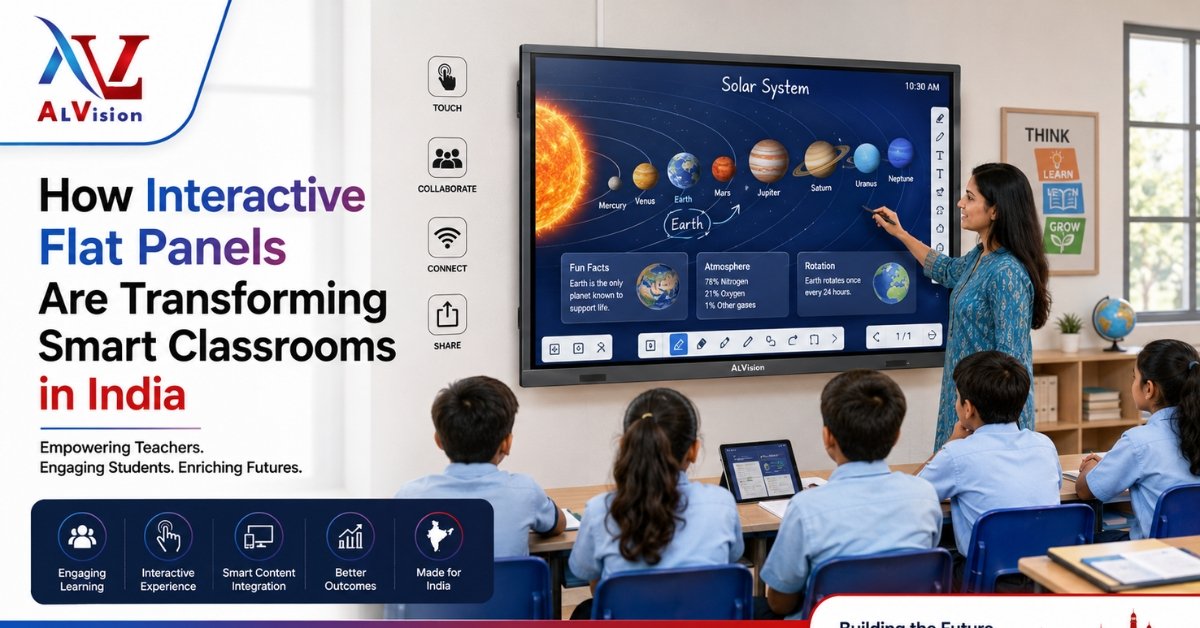
The Indian education system is undergoing a profound shift. Across government schools in rural Bihar, private institutions in metropolitan Mumbai, and engineering colleges in Bengaluru, classrooms are shedding their chalk-and-blackboard identity in favour of something far more dynamic. At the heart of this transformation are Interactive Flat Panels, large-format touch-enabled displays that are redefining what a learning environment looks and feels like.
This is not a niche trend. With the Indian government’s thrust on digital education through initiatives such as the National Education Policy 2020 and programmes like PM eVIDYA, schools and colleges are under pressure to modernise their teaching infrastructure. Interactive Flat Panels have emerged as the most versatile and impactful piece of smart classroom technology available today, combining the familiarity of a whiteboard with the power of a connected computer, a media player, a collaboration tool, and much more.
From Blackboards to Bright Screens: The Classroom Evolution
For generations, the Indian classroom was defined by three things: a teacher, a blackboard, and chalk. This model served its purpose, but it was fundamentally passive. Students listened, copied notes, and hoped they absorbed enough to pass an examination. The interactive element was largely absent.
The arrival of projectors in the early 2000s introduced digital content to classrooms, but projectors were never truly interactive. They simply projected information onto a surface without allowing students or teachers to engage with it directly. Interactive whiteboards represented the next step, but they came with calibration issues, required a separate projector setup, and were expensive to maintain.
Interactive Flat Panels solve these problems in one integrated device. They are essentially large-screen Android or Windows-based computers with built-in displays, speakers, cameras, and touch functionality. The teacher can write on the screen with a finger or stylus, open lesson videos, annotate PDF documents, run educational apps, and share the screen wirelessly with students, all from a single device mounted on the classroom wall.
What Makes Interactive Flat Panels Ideal for Indian Schools
The appeal of IFP for education is not simply about novelty. Several practical features make these panels a genuine upgrade over anything that came before them.
20-Point Multi-Touch Display
Modern Interactive Flat Panels come with a 20-point multi-touch display, meaning up to twenty simultaneous touch points can be recognised on the screen. In a classroom setting, this is transformative. Multiple students can gather around the panel and interact with it at the same time, working through a maths problem together, manipulating a diagram, or sorting information in a group activity. This encourages collaboration and peer learning in a way that no traditional teaching tool ever could.
Interactive Annotation Tools for Education
Teachers can write, draw, highlight, and annotate directly on whatever is displayed on the screen. If a history lesson is underway and a map of the Mughal Empire is shown, the teacher can circle key cities, draw arrows showing trade routes, and add notes in real time. These annotations can be saved instantly and shared with students as digital files, meaning no information is lost when class ends. The interactive annotation tools available on these panels make lessons far richer and more visually engaging than static slides or printed handouts.
Wireless Screen Sharing in the Classroom
One of the most valued features among educators is wireless screen sharing. A teacher can mirror their laptop or tablet on the panel without a single cable. Students can also share their own device screens with the class, presenting their work or demonstrating a solution directly from their seat. This two-way wireless capability removes the physical bottleneck that cable-based setups always created and makes the classroom more fluid and participatory.
Touch Screen Display Built for Durability
A touch screen display for the classroom must endure years of daily use by children of varying age groups. Quality Interactive Flat Panels are designed with tempered anti-glare glass that resists scratches, smudges, and impact. The screen remains clearly visible even in well-lit rooms, which matters greatly in Indian classrooms where curtains and blinds are not always available. The display technology also reduces eye strain for prolonged use, an important consideration for students who spend multiple periods in front of the panel.
Smart Classroom Technology in India: The Broader Picture
India’s education sector is the largest in the world by student numbers. With more than 250 million students enrolled in schools and higher education institutions, the scale of the digital learning challenge is enormous. Fortunately, smart classroom technology in India has evolved rapidly over the past five years.
State governments including those of Uttar Pradesh, Rajasthan, Kerala, and Tamil Nadu have launched programmes specifically aimed at equipping classrooms with digital learning tools. Private school chains and coaching institutes have been even faster to adopt, recognising that parents now consider technology infrastructure when choosing a school for their children.
Within this ecosystem, the Interactive Flat Panel has become the centrepiece of what educators call the smart classroom setup. It replaces not just the blackboard but the projector, the DVD player, the document camera, and even the dedicated computer terminal. A single panel, when properly integrated with a school’s content management system and internet connection, becomes the entire digital teaching station.
ALVision’s Smart Classroom Solutions are purpose-built to address the specific needs of Indian educational institutions, offering end-to-end integration that goes well beyond simply supplying a display.
How Digital Learning Tools Are Changing Student Outcomes
The argument for digital learning tools in India is no longer theoretical. Schools that have introduced Interactive Flat Panels consistently report improvements in student attention, participation, and retention. The reasons are well understood by educators.
Visual learning is more effective for the majority of students. When a biology teacher can display a three-dimensional animation of cell division instead of drawing a static diagram on the board, the concept becomes immediately clearer. When a physics teacher can run a simulation of projectile motion and let students adjust variables in real time, the abstract becomes concrete.
Engagement is also significantly higher in technology-equipped classrooms. Students who previously struggled to stay focused during a forty-five-minute lecture find it far easier to remain attentive when content is dynamic, visually rich, and occasionally interactive. Teachers report that even students who rarely raised their hands in traditional classroom settings become more willing to participate when asked to come up and interact with the panel.
There is also a practical equity argument. When a teacher saves annotated lesson notes from the panel and shares them with the class digitally, students who were absent due to illness, or those who simply could not write fast enough to keep up, no longer fall behind. The lesson is preserved and accessible.
Interactive Whiteboard for School vs. Interactive Flat Panel: Understanding the Difference
Many school administrators still use the terms interactive whiteboard and Interactive Flat Panel interchangeably, but they are different products with very different capabilities.
A traditional interactive whiteboard for school is a passive touch surface that requires an external projector to display content. The projector must be aligned with the whiteboard precisely, a process that frequently goes out of calibration. The image quality depends entirely on the projector’s lamp, which fades over time and eventually needs expensive replacement. Ambient light in the room can wash out the projected image.
An Interactive Flat Panel, by contrast, has its own built-in display, processor, operating system, and software. It requires no projector. The display is bright, sharp, and visible in any lighting condition. There are no lamps to replace. The touch response is instantaneous and accurate. Software updates can be delivered wirelessly. The total cost of ownership over five years is typically lower than maintaining a projector-based interactive whiteboard system.
Schools considering an upgrade can explore the full range of Interactive Flat Panels from ALVision, which are specifically designed to meet the demands of high-usage educational environments.
The Role of the Digital Podium in a Complete Smart Classroom
While the Interactive Flat Panel forms the centrepiece of a modern smart classroom, it is increasingly paired with complementary tools to create a fully equipped teaching environment. One of the most practical additions is the digital podium.
A digital podium gives the teacher a dedicated control station from which to manage lesson delivery, connect to the panel wirelessly, and address a larger audience in auditorium or seminar settings. It combines a microphone, display interface, and connectivity hub in a single unit, eliminating the clutter of multiple devices on the teacher’s desk.
ALVision’s Digital Podium is designed to complement its Interactive Flat Panels, giving educators a unified solution for both classroom instruction and larger presentations.
Considerations for Schools Adopting IFP Technology
For school administrators evaluating Interactive Flat Panels for the first time, a few considerations deserve attention.
Screen size matters for classroom dimensions. A panel intended for a standard twenty-by-twenty-foot classroom should be at least 75 inches diagonally, while larger halls may require 86 inches or more to ensure visibility from the back row.
Operating system flexibility is important if the school already uses specific software. Most quality panels offer both Android and Windows modes, allowing schools to run their existing educational platforms without replacing them.
Connectivity options should include HDMI, USB, and wireless casting to accommodate different devices brought by teachers and students.
After-sales support and warranty coverage are especially important in India, where technical support in tier-two and tier-three cities has historically been limited. Schools should prioritise suppliers with a pan-India service network.
BIS certification and compliance with Indian standards are also worth verifying, particularly for government school procurement through the GEM portal.
The Road Ahead for Smart Classrooms in India
India’s ambition to become a knowledge economy by 2047 depends significantly on improving the quality of education at scale. Smart classroom technology is not a luxury reserved for elite schools. With costs falling steadily and government subsidy programmes expanding access, Interactive Flat Panels are becoming viable for a much wider range of institutions than was conceivable even five years ago.
The trajectory is clear. Immersive content, AI-assisted lesson planning, real-time student assessment tools, and integration with national digital learning platforms will continue to evolve on top of the IFP hardware foundation. Schools that invest now are not just buying a display; they are building the infrastructure for the next decade of learning.
For manufacturers and solution providers such as ALVision, the commitment goes beyond hardware supply. The focus is on ensuring that the technology is installed correctly, teachers are trained to use it confidently, content is available in regional languages, and support is accessible nationwide. These elements together determine whether a smart classroom genuinely transforms learning or remains an expensive display on a wall.
Conclusion
Interactive Flat Panels represent the most significant advancement in classroom technology since the introduction of the printed textbook. For India, a country with the scale, diversity, and ambition to completely reinvent its education system within a generation, these panels offer a practical, proven, and increasingly affordable path forward.
From the 20-point multi-touch display that invites students to learn by doing, to the wireless screen sharing capability that makes every student a potential presenter, to the interactive annotation tools that preserve the best of traditional teaching while expanding its possibilities, the Interactive Flat Panel is not just changing how classrooms look. It is changing how an entire generation of Indian students learns.