Active LED video walls are replacing LCD and projector-based displays across corporate offices, retail stores, and auditoriums in 2026. This guide breaks down the five biggest reasons why — brightness, seamless design, lifespan, flexibility, and total cost of ownership — plus the buying angle most guides skip: real running costs after installation. We also answer the top 10 questions buyers ask before choosing a commercial LED display.
Active LED video walls are outperforming traditional displays in 2026 because they deliver higher brightness, a truly seamless picture, longer operational life, and lower long-term running costs — even though the upfront price is higher. If your business runs a display for more than 8–10 hours a day, in a bright room, or in front of customers, an active LED video wall pays for itself faster than most buyers expect. Below, we break down exactly why, where the numbers come from, and how to choose the right one.

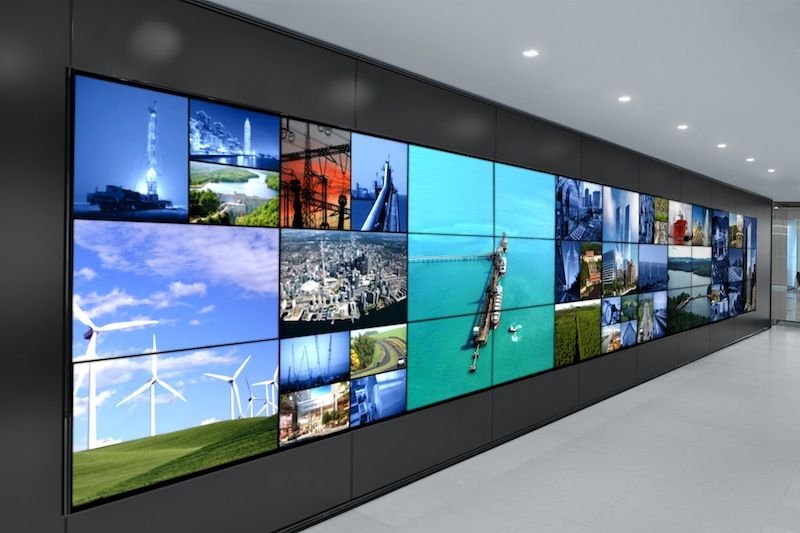
An active LED video wall is a large-format display built from small LED tiles or cabinets that are actively driven — meaning every pixel produces its own light instead of relying on a backlight, as LCD panels do. The tiles are joined edge-to-edge to form one continuous screen of almost any size, with no visible seams or bezels. We call it “active” because the diodes themselves generate the image in real time, giving it far higher brightness and contrast than a backlit panel. This is different from a commercial LED display, which is a broader category that can include everything from a single fine-pitch panel to a full multi-cabinet video wall.
In short: An active LED video wall is a modular, self-lit screen designed for continuous commercial use — built for visibility, not just viewing.
A commercial LED display is any LED-based screen built for business, retail, corporate, or public-space use rather than home entertainment. It is engineered for longer daily run-time, brighter ambient lighting, and heavier duty cycles than a consumer TV. Common formats include:
Traditional displays — LCD video walls, projectors, and standalone monitors — were built for a different era of business use. Active LED video walls solve five specific problems that traditional displays still struggle with. Here is what we see in the field, reason by reason.
The problem: LCD panels and projectors lose visibility the moment sunlight or strong ambient light hits the screen.
The LED advantage: Active LED video walls commonly run at 600–5,000+ nits depending on the model, compared to roughly 300–500 nits on most commercial LCD panels. That difference is the gap between a screen you squint at near a window and one that stays crisp all day.
Actionable step: If your display sits in a lobby, showroom, or any space with natural light, treat brightness as a non-negotiable spec — ask any supplier for the nit rating in writing, not just “bright enough for indoor use.”
The problem: LCD video walls are built from individual panels with visible bezels between them, which breaks up video content and looks dated on camera.
The LED advantage: A seamless LED video wall is built from tiles with almost zero gap, so the image reads as one continuous canvas — critical for branding, control rooms, and video content where a black grid line across a face or logo is unacceptable.
Actionable step: Ask to see a live demo unit up close, not a rendered image, before signing off on any “seamless” claim.
The problem: Projectors need bulb replacements every few thousand hours, and LCD panels are rated for roughly 16–18 hours of daily use before their lifespan drops sharply.
The LED advantage: Commercial-grade LED diodes are typically rated for 50,000–100,000+ hours of operation, which supports true 24/7 use in control rooms, transit hubs, and retail environments without the display degrading.
Actionable step: For any control room, banking, or transportation project, confirm the panel is rated for continuous operation — not just “commercial use” — before you commit.
The problem: LCD and projector setups are locked into fixed panel sizes or a rectangular throw, which limits design options.
The LED advantage: Because a large-format LED display is built from modular tiles, it can be configured into almost any size, aspect ratio, or even curved and creative shapes — something no LCD video wall or projector can match.
Actionable step: If your space has an unusual wall, column, or reception desk shape, ask your LED display manufacturer for a custom configuration rather than settling for a standard rectangle.
The problem: Buyers often compare only the upfront price and assume LCD is “cheaper.”
The LED advantage: Once you factor in bulb replacements, panel burn-in, higher power draw per nit of brightness, and a shorter usable life, an indoor LED display frequently costs less per operating hour over a 5–7 year period — even though it costs more on day one.
Actionable step: Ask any vendor for a cost-per-year estimate over the display’s rated lifespan, not just the purchase price, before comparing quotes.
Most articles on this topic stop at brightness and picture quality. In our experience selling and installing commercial LED video walls across corporate, government, and retail projects in India, three things actually decide whether a buyer is happy two years later — and almost nobody talks about them upfront.
An LED video wall works by combining rows of red, green, and blue diodes across small tiles or cabinets. Each diode is individually addressed by a control system, which maps out one large image across every tile in real time. A dedicated video processor splits the incoming signal — from a laptop, media player, or content management system — and sends the correct portion to each cabinet, so the wall behaves as a single screen rather than several separate ones.
Commercial LED display pricing depends primarily on pixel pitch, screen size, indoor vs. outdoor rating, and brightness level. As a general pattern:
Actionable step: Always request a line-item quote (panel cost, processor, mounting, installation, AMC) rather than a single bundled number — it is the only way to compare a commercial LED display price across suppliers accurately.
Yes. Commercial-grade LED video walls are specifically engineered for high-traffic, always-on environments like airports, banks, control rooms, and retail flagship stores. The diodes are rated for tens of thousands of operating hours, and the modular tile design means a single damaged module can be swapped without replacing the entire wall — something that isn’t possible with a one-piece LCD panel.
We’ve covered specific use cases in more depth in our posts on the industries getting the most value from LED video walls and how LED screens fit into a well-designed auditorium.
1. What is the difference between an LED video wall and a traditional display?
An LED video wall is self-lit and modular, built from tiles joined into one seamless screen. A traditional display, like an LCD panel or projector, relies on a backlight or bulb and has visible bezels or brightness limits.
2. Are LED video walls better than LCD displays?
For business use, generally yes — LED walls are brighter, last longer, and have no visible seams. LCD can still make sense for smaller budgets or shorter daily run-times. We compare this in detail in Active LED Video Wall vs LCD Video Wall.
3. What pixel pitch is best for an indoor LED video wall?
It depends on viewing distance. Closer viewing (under 10 feet) needs a finer pitch like P1.5–P2.5; larger auditoriums viewed from 20+ feet can use P3–P4 without losing sharpness.
4. Can LED video walls display 4K content?
Yes, as long as the wall’s total pixel resolution matches or exceeds 4K and the video processor supports a 4K input signal.
5. How much maintenance does an LED video wall require?
Routine maintenance is minimal — mainly dust cleaning and periodic diagnostic checks. Modular tiles also mean a faulty section can be replaced individually instead of servicing the whole wall.
6. What is the lifespan of a commercial LED display?
Commercial-grade LED displays are typically rated for 50,000–100,000+ operating hours, which translates to well over a decade of daily use in most business settings.
7. Are LED video walls suitable for 24/7 operation?
Yes, when built with commercial-grade diodes and proper thermal management, LED video walls are designed to run continuously without significant brightness loss.
8. What factors affect LED video wall pricing?
Pixel pitch, screen size, indoor/outdoor rating, brightness level, and installation complexity are the main factors that move the final price.
9. How do LED video walls improve customer engagement?
Their brightness and seamless picture hold attention longer in retail and event settings, and dynamic content can be updated instantly — something static signage can’t match.
10. Which LED display manufacturer is best in India?
Look for a manufacturer with in-house engineering, BIS/ISO certification, and pan-India installation and service support — not just a trading or import setup. ALVision Digital is one such India-based OEM/ODM manufacturer with in-house production and nationwide support.
Traditional displays haven’t disappeared, but for any business that needs a screen to stay bright, seamless, and reliable day after day, active LED video walls have become the clear default in 2026. The upfront cost is higher — but brightness that holds up in real lighting, a picture with no visible seams, and a diode lifespan measured in decades rather than years change the math over time.
If you’re evaluating a commercial LED display for your office, showroom, or control room, the details that matter most — pixel pitch, duty cycle, and local service support — rarely show up in a spec sheet. That’s the conversation worth having before you buy.
At ALVision Digital, we design, manufacture, and install active LED video walls and commercial LED displays across India, backed by in-house OEM/ODM engineering and pan-India installation support. See Our Full Range of Services or get a free consultation for your project to find the right display for your space.
C-159, Block C, Sector-63, Noida,
Sector 63, Gautam Buddha Nagar,
Uttar Pradesh, 201301.
1st Floor, Flat No. 1135, Tower-10,
Arocon Golf Ville, Near Crossing Republic,
Ghaziabad, Uttar Pradesh, 201016.
C-159, Block C, Sector-63, Noida,
Sector 63, Gautam Buddha Nagar,
Uttar Pradesh, 201301.
1st Floor, Flat No. 1135, Tower-10,
Arocon Golf Ville, Near Crossing Republic,
Ghaziabad, Uttar Pradesh, 201016.